How to Manage Fearful and Obsessive Thoughts
You can manage fearful thoughts by changing responses using ERP.

How Can You Manage Fearful and Intrusive Thoughts?
You can manage fearful and intrusive thoughts by changing how you respond to them rather than trying to eliminate them. Helpful strategies include recognizing thoughts as mental events, allowing uncomfortable feelings to pass, avoiding reassurance cycles, redirecting your attention, practicing coping skills, and seeking professional support when needed.
What Are Fearful and Intrusive Thoughts?
Fearful thoughts are distressing ideas that pop into your mind and make you feel stressed out or upset. They often appear automatically, and it’s common to feel worried, ashamed, or overly critical when they show up.
Some thoughts are intrusive—unwanted, persistent, and hard to control. Sometimes these thoughts are connected to conditions like OCD, which can trigger physical or mental rituals. Recognizing this is the first step toward gaining control—it’s not a reflection of personal weakness.
Fearful thoughts affect both mind and body. You may feel tense, restless, or mentally drained, and notice symptoms like a racing heart, muscle tension, or shallow breathing. Over time, these thoughts can lead to avoidance or a persistent sense of unease. Knowing how they affect you is a key step toward managing them effectively.
How Can You Manage Intrusive Thoughts in the Moment?
It’s normal for intrusive thoughts to feel upsetting, repetitive, or difficult to ignore. With practice, you can learn to respond to these thoughts differently instead of getting caught up in them. The following strategies may help you manage intrusive thoughts and the anxiety they can create.
1. Do not focus on your fearful thinking:The first thing a person should do is not dwell on the fear-provoking thought when it comes. The more a person tries to determine the fear behind the thought, the stronger it becomes. Label these thoughts as “intrusive thoughts” and allow the thoughts into your mind. Do not try to push them away, but rather just let the thoughts pass.
2. Think of a red stop sign:At times, a person might encounter a fearful thought that may be difficult to manage. When this happens, visualize a red stop sign which can serve as a reminder to think about something else. Regardless of how scary your negative thinking may be, do not dwell on it. This technique is great in dealing with your anxieties and depression.
3. Journal your thoughts:Journaling can be a great way to reduce intrusive thoughts. Reading the thought rather than thinking about it can help create a better perspective on your situation. Writing down your thoughts helps with mental clarity and emotional processing which reduces stress and anxiety.
4. Your thoughts are exaggerated:Sometimes, a person may encounter a lot of scary thoughts coming at them all at once. Instead of getting upset, remember that your negative thinking is exaggerated with worry. Ignore the fear behind these obsessive thoughts, regardless of how strong the fear is.
5. Distract yourself:You can distract yourself from your intrusive thoughts. For instance, call a close friend, go to the gym, watch your favorite show, read a book, listen to music, or take a walk. Whether you change your location or engage in a new activity, distracting yourself can break up disturbing thought loops before they spiral out of control.
6. Carry a small notebook of positive statements:A person should keep a small notebook of positive statements that makes them feel good. Whenever they come across an uplifting verse that makes them happy, write it down in a small notebook. A person can carry this notebook in their pocket and whenever they feel anxious, they can read their notebook.
7. Exercise:Physical exercise is a great way to minimize unwanted thoughts. When you exercise, your brain releases serotonin, a feel-good chemical that is helpful in relieving stress. Any form of movement such as walking can help you keep intrusive thoughts at bay.
8. Its only fear:The difference between an obsessive thought and a regular one is that an obsessive thought is based on fear. Find the source of the fear behind your negative thinking and find ways to take away the fear.
9. Get help:Take advantage of the help that is available. If possible, talk to a professional who can help you manage your fears and anxieties. They will be able to provide you with additional advice and insights on how to deal with your intrusive and fearful thoughts.
What Is OCD and How Does It Affect Intrusive Thoughts?
According to the National Institute of Mental Health (NIMH), obsessive-compulsive disorder (OCD) involves recurring, narrow thinking, unwanted thoughts, urges, or images called obsessions, as well as repetitive behaviors or mental acts called compulsions. These symptoms can cause significant distress and may interfere with daily activities.
People with OCD may experience intrusive thoughts, fears, or concerns that create anxiety or discomfort. In response, they may feel an urge to perform a physical or mental compulsion to reduce the distress or gain a sense of certainty.
Compulsions can include behaviors such as repeated checking, cleaning, counting, or arranging. They can also involve mental activities, such as repeatedly analyzing a situation, reviewing past events, seeking reassurance, or trying to determine whether a feared outcome will occur.
These responses may provide temporary relief, but repeatedly responding to intrusive thoughts with compulsions can keep a person focused on the fear or uncertainty. Understanding the difference between an intrusive thought and the response to that thought can be an important part of learning how to manage these experiences.
What Is Purely Obsessional OCD (Pure O)?
Purely Obsessional OCD (“Pure O”) is a form of obsessive-compulsive disorder in which the compulsions are primarily internal rather than visible. Compulsions are still present—they simply take place in the mind instead of through obvious behaviors.
With OCD, many people experience a strong need for absolute certainty and reassurance about things like intent, identity, relationships, or safety. Because 100% certainty is impossible, the mind keeps searching through repeated checking, analysis, and reassurance, and the ongoing struggle with the thought which keeps the cycle alive.
A Layman’s Guide to Managing Fear has 200+ practical strategies for fear, worry and anxiety.
Get the book · $9.99What Are OCD Compulsions?
Physical rituals/compulsions: Repetitive physical behaviors performed to reduce distress, gain control, or prevent a feared event caused by obsessive thoughts. Common rituals include excessive cleaning, checking, counting, ordering, and mental reviewing, which often consume significant time and interfere with daily life.
Mental rituals/compulsions: Repetitive, hidden mental acts performed by individuals with OCD to reduce anxiety or neutralize intrusive thoughts. Unlike physical rituals, these are internal. They are intentional, self-reinforcing behaviors that temporarily reduce distress but ultimately perpetuate the cycle of obsessions.
Examples: Overanalyzing, predicting the future, and obsessing over a situation; having a specific thought that says something negative to you; trying to reason with intrusive thoughts; engaging in self-reassurance; checking how certain things or thoughts make you feel; mentally reviewing past experiences to feel completely certain; and trying not to think about something.
What Are Helpful Coping Statements for Negative Thoughts?
- Don’t push the thought away. Let it be there.
- Don’t jump to conclusions or predict what will happen.
- Shift attention back to what is happening right now.
- This feeling isn’t pleasant, but it will not last.
- I can be anxious and still deal with this situation.
- This isn’t an emergency. It’s okay to think about what I need to do.
- I will take deep breaths to decrease my anxiety.
- Breathing will decrease your anxiety, which will help you to start thinking better.
- OCD is trying to convince you there is a threat when there is no threat. It’s a perceived threat.
- OCD makes assumptions into facts. Do not jump to conclusions and do not predict what may happen.
- Label the thought as an OCD thought. Recognize what OCD is telling you.
- This is an opportunity for me to learn to cope with my fears.
- I can take a small step forward.
- I’ve survived this before and I’ll survive this time too.
- I can do my coping strategies and allow this to pass.
- These are just thoughts, not reality. I can think differently.
- Do not push the OCD thought away. It will make it worse.
- Take deep breaths to reduce your anxiety.
- Notice your intrusive thoughts and let the thoughts pass.
- Do not listen to your OCD. Your OCD exaggerates reality.
- Do not take your OCD thought seriously. It’s a thought and thoughts come and go.
- The fear will not last. The fear will eventually decrease and go away.
- Distract yourself and focus on something else.
- I do not need to rush. I can take things slowly.
- My thoughts are not necessarily true or factual.
- It takes time to adjust to new things. You will learn how to cope.
- I can learn from this, and it will be easier the next time.
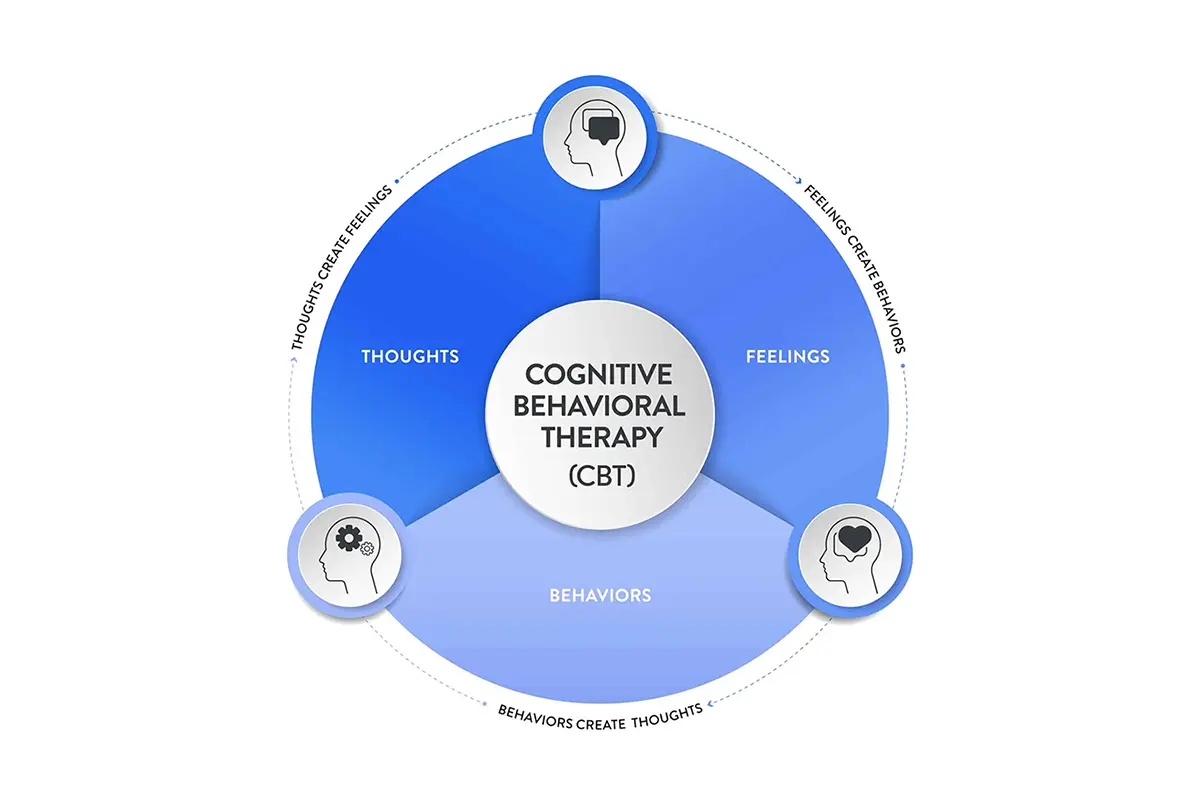
How Does Cognitive Behavioral Therapy Help With OCD?
Cognitive Behavioral Therapy (CBT) helps people identify and change the thought patterns and behaviors that keep anxiety and compulsions going. Instead of accepting fearful thoughts as facts, clients learn to spot unhelpful thinking patterns—like catastrophizing, overestimating danger, or intolerance of uncertainty—that make anxiety worse.
For anxiety, CBT supports individuals in challenging exaggerated or distorted predictions, gradually facing feared situations through structured exposure, reducing avoidance and safety behaviors, and building confidence through repeated practice. In addition to these strategies, CBT teaches practical coping skills—such as relaxation techniques, mindfulness, and structured problem-solving—that help people manage anxiety effectively in the moment.
How Exposure and Response Prevention Helps with OCD
Exposure and Response Prevention (ERP) is a well-established behavioral therapy for OCD and is commonly recommended as a first-line treatment. ERP involves gradually facing feared situations or thoughts (exposure) while resisting compulsive behaviors (response prevention), retraining the brain to tolerate anxiety and reduce fear over time. For OCD, ERP focuses on retraining the brain’s fear system rather than trying to eliminate fear altogether. Instead of avoiding anxious thoughts or attempting to neutralize discomfort, individuals learn to change their response to it.
According to the American Psychological Association (APA), ERP is a behavioral treatment used for OCD that involves exposure to feared situations or thoughts while helping individuals resist compulsive responses.
Treatment emphasizes allowing anxiety to be present, resisting compulsions and safety behaviors, and staying in feared situations long enough for distress to naturally rise and fall. This process teaches the brain an essential lesson: fear is uncomfortable, but it is not dangerous. Through repeated practice, the brain learns that anxiety naturally rises and falls without causing harm, which gradually reduces the urge to perform compulsions.
What Are the Four Elements of ERP?
The following are the four key elements of Exposure and Response Prevention (ERP) and how they can help people manage obsessive thoughts, anxiety, and compulsive behaviors.
1. The trigger:Exposures are planned therapeutic experiences, during which you purposely expose yourself to a feared situation (the trigger) that causes you to experience uncomfortable thoughts and emotions.
2. Prevention:While you are in your feared situation, you need to resist the urge to engage in the rituals and avoidance that you usually would do.
3. Habituation:Habituation refers to becoming more accustomed to anxiety or discomfort through repeated exposure to feared situations without performing compulsions. Instead of avoiding the situation or using a ritual to reduce anxiety, you remain in the situation and allow the uncomfortable feelings to be present. Over time, you can learn to tolerate anxiety without relying on compulsions.
Habituation is similar to getting into a pool of cold water. At first, the water feels uncomfortable, and you may want to get out. Eventually you will feel comfortable in the water. Similarly, OCD can create an urge to escape anxiety by performing a compulsion. With ERP, the goal is to stay in the situation without performing the compulsion and allow the discomfort to decrease naturally.
4. SUDS:This is a 0–100 self-report tool used in ERP. Sample ratings are from zero which is no anxiety to 100 which is the highest anxiety possible. It helps to measure, track, and manage anxiety levels during exposure exercises. It measures the “heat” of anxiety at a specific moment.
What Is the OCD Anxiety Curve and How Does Anxiety Rise and Fall?
When you face a feared thought, situation, or trigger without performing your usual compulsion, anxiety may rise and change over time. An anxiety curve can be used as a simple way to illustrate how these feelings may increase, remain intense for a period, and eventually change without relying on a ritual or avoidance.
At the beginning of an exposure, anxiety may increase as you face something that feels threatening or uncomfortable. The anxiety can feel intense, but it does not necessarily mean that something dangerous is happening. Instead of performing a compulsion to make the anxiety go away, ERP encourages you to allow the discomfort to be present and continue without performing the usual ritual.
The anxiety will eventually decrease, although this does not happen in exactly the same way or at the same speed during every exposure. The important lesson is that you can experience anxiety and uncertainty without needing to perform a compulsion to feel safe.
With repeated practice, you can learn that uncomfortable thoughts and feelings do not require an immediate response. Over time, this can help you become more comfortable with uncertainty, reduce your reliance on compulsions, and respond to intrusive thoughts in a different way.
My Personal Experience
I have lived with fear and anxiety for more than 20 years, and I have learned that intrusive and fearful thoughts can be difficult to handle. In my experience, trying to eliminate every troubling thought can sometimes keep me focused on the fear.
For example, I remember having intrusive thoughts while trying to finish a project at work. I worried that I would miss the deadline and lose my job. I decided to take a few deep breaths and redirect my attention to the task in front of me. Although the worry did not disappear, I was better able to focus on what I could do at that moment.
I learned that repeatedly focusing on fearful thoughts was not helpful for me. Pausing, calming myself, and taking one step at a time helped me respond more effectively.
If you or someone you know is in crisis in the U.S., call or text 988 to reach the 988 Suicide & Crisis Lifeline, available 24/7. This article is educational and is not a substitute for professional care.
Stan is the author of A Layman’s Guide to Managing Fear and the creator of the Managing Fear Framework. He has lived with anxiety for more than 20 years and has been featured on 30+ TV and radio programs.
More about Stan →