How to Deal With Panic Attacks: Practical Coping Strategies
A panic attack can feel frightening, but it is temporary and will pass. Here are practical steps to calm your body, challenge fearful thoughts and regain a sense of control.


What Should You Do During a Panic Attack?
A panic attack can feel frightening, but it is temporary and will pass. Helpful strategies include slowing your breathing, reminding yourself that the sensations of panic are temporary, focusing on the present moment, and avoiding reacting to fearful thoughts. With practice, these strategies can help reduce the intensity of panic attacks and help you regain a sense of control.
What Is a Panic Attack?
A panic attack is a sudden surge of intense fear or anxiety that can feel completely overwhelming. Your heart might race, your breathing might feel short and tight, you could feel dizzy, or even think you’re having a heart attack. Panic attacks usually peak within a few minutes, but the aftereffects—like lingering tension or worry—can stick around a bit longer.
Panic attacks can happen to anyone, even if you don’t have a diagnosis—they’re just your body’s alarm system going off. Even if it feels scary, it will pass, and you can learn ways to calm yourself in the moment. Repeated attacks can make daily life feel tricky, but taking small steps can help you regain control and reduce their impact over time.
According to the National Institute of Mental Health (NIMH), panic attacks can involve intense fear and physical symptoms such as a racing heart, sweating, trembling, and difficulty breathing.
What Are the Signs of a Panic Attack?
You might experience a sense of doom, a loss of control, or fear that you’re dying or having a heart attack. Some people feel detached from reality or notice tunnel vision, while physical symptoms can include a rapid heartbeat, shortness of breath, or gasping. Other common signs include sweating, nausea, muscle tension, chest pain, or lightheadedness.
13 Steps to Take During a Panic Attack
A panic attack can feel frightening, but there are practical steps you can take to manage the symptoms and cope with the fear. The following strategies can help you respond to panic more calmly and regain a sense of control.
1. Learn your triggers: Certain things may trigger panic attacks. By learning to manage or avoid these triggers, you may be able to reduce the frequency and intensity of your panic attacks. Panic attacks can happen unexpectedly, even without a clear trigger.
2. Recognize that you’re having a panic attack: Notice what’s happening and remind yourself it’s a temporary surge of anxiety, not real danger. Set aside the fear or sense of impending doom; both are normal symptoms of a panic attack.
3. Take deep breaths: Panic attacks can cause rapid breathing and chest tightness, making your breaths shallow. Shallow breathing can worsen feelings of anxiety and tension. Instead, breathe slowly and deeply, concentrating on each breath. Inhale deeply from your abdomen, filling your lungs steadily, and exhale while counting to four.
4. Find a peaceful and safe spot: If possible, move to a quieter or less stimulating place. This might mean stepping outside, sitting down, or leaning against a wall for support. Reducing noise and activity around you can help your nervous system settle and make it easier to focus on your breathing and calming strategies.
5. Distract yourself: A person should distract themselves from the panic they are experiencing. A person could get some fresh air, listen to some music, take a brisk walk, read the newspaper, or do something relaxing that will give them a fresh perspective on things.
6. Picture a happy place: A person’s happy place can be somewhere where they feel relaxed, safe, and calm. The specific place will be different for everybody. When a panic attack begins, it can help you to close your eyes and imagine being in your happy place.
7. Visualize a red stop sign: A person should visualize a red stop sign in their mind when they encounter a fearful thought. When the negative thought comes, a person should think of a red stop sign that serves as a reminder to stop focusing on that thought and to think of something else.
8. Get the facts of your situation: Do not focus on your worrying and fearful thoughts. Focus on the facts of your current situation rather than what you may think.
9. Don’t dwell on your thoughts: A person should not dwell or focus on their thoughts during a panic attack. Fear and worry exaggerate your thoughts. The more a person tries to reason out their thoughts the longer a panic attack will last.
10. Read some positive affirmations: A technique that is helpful is to have a small notebook of positive statements that makes you feel good. Whenever you find an affirmation that makes you feel good, write it down in a small notebook that you can carry in your pocket. When you feel anxious, read a positive affirmation from your notebook.
11. Focus on your surroundings: Shift your attention to the present moment by noticing what is around you. Look for things you can see, hear, touch, or smell. You might count objects of a certain color, describe an object in detail, or feel your feet firmly on the floor. Bringing your attention to your environment helps interrupt racing thoughts and grounds you in the present.
12. Reassure yourself: Remind yourself that what you’re feeling is anxiety, not real danger. Panic attacks can feel frightening, but they are a temporary stress response from your body. Try repeating a calming phrase such as, “This is uncomfortable, but I am safe,” or “I can handle this.” Gentle reassurance helps reduce fear and allows your body to gradually calm down.
13. Do some light exercise: Walking can remove a person from a stressful environment and can help regulate breathing. Moving around releases hormones called endorphins that relax the body and improve mood.
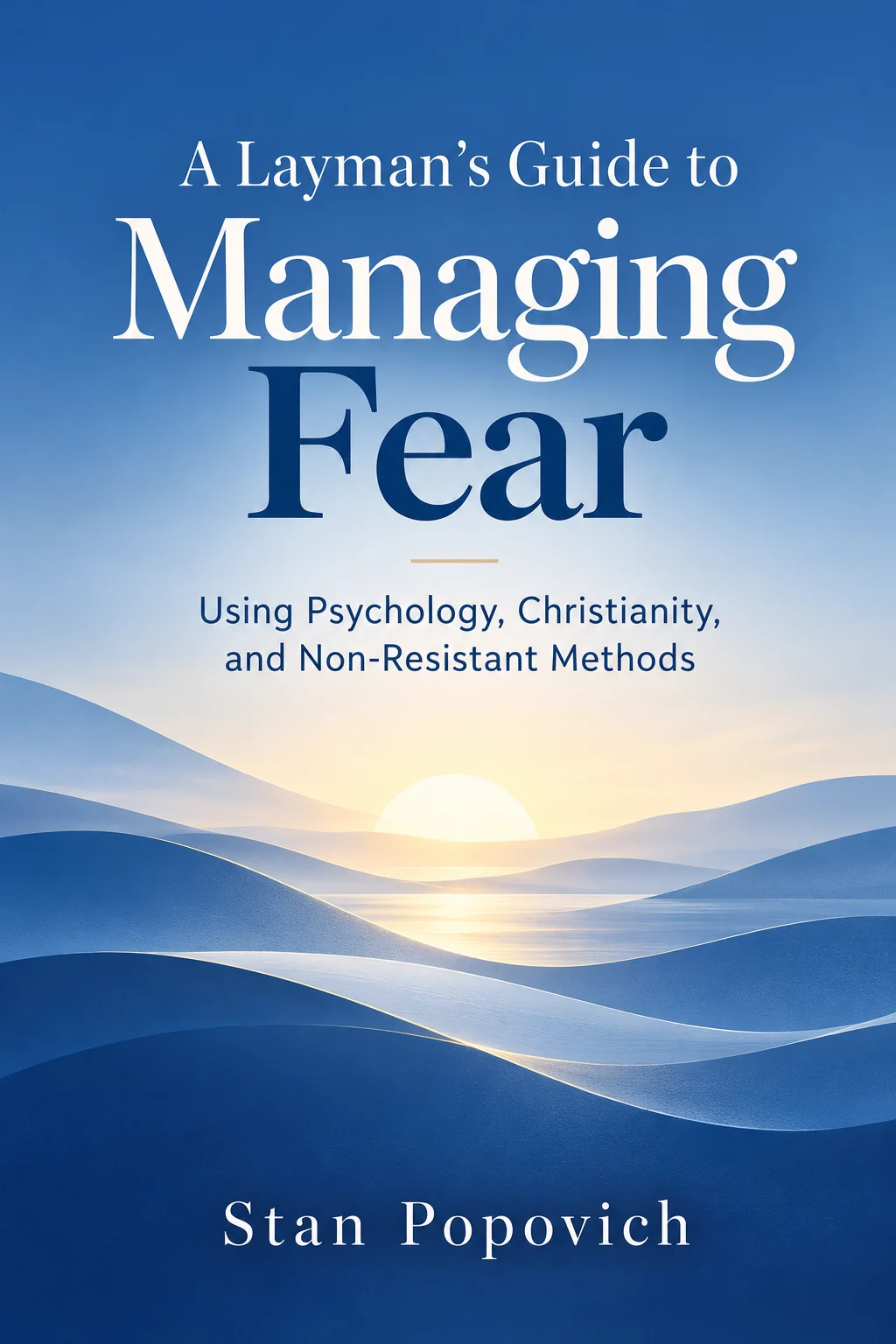
A Layman’s Guide to Managing Fear has 200+ practical strategies for fear, worry and anxiety.
Get the book · $9.99The Panic Attack Cycle
The panic attack cycle describes how a perceived threat can trigger physical reactions, increase fear, and lead to a panic attack. Understanding this cycle can help you recognize how your thoughts and body sensations interact during moments of intense anxiety.
- An Event Occurs
- The Event Is Considered a Perceived Threat
- Your Body Releases Adrenaline
- Your Breathing/Heart Rate Increases
- Panic Occurs
How Can You Stop a Panic Attack Cycle?
A panic attack cycle can become more intense when fearful thoughts and physical sensations reinforce each other. Learning to slow your breathing and evaluate anxious thoughts can help you respond more calmly and regain a sense of control.
1. Breathe first: The first thing to do is to breathe to stop the anxiety cycle. Your anxiety makes it harder to manage your current situation. Anxiety makes everything much worse. The less anxiety you have, the easier it is to do things and to think more clearly. Breathing helps reduce your anxious thoughts. After you breathe, you can do other calming methods to manage your anxiety.
2. Challenge anxious thoughts: Anxiety can cause your mind to jump to worst-case scenarios or assume something is dangerous when it may not be. Instead of automatically believing these thoughts, pause and ask yourself what is the evidence and the facts that support your perceived threats and worse-case scenarios. Evaluate your anxious thoughts based on common sense. Look at the facts of the situation rather than relying on assumptions or “what-ifs.”
How Can You Stop “What-If” Thinking During Panic?
“What-if” thoughts are hypothetical scenarios your mind creates—just because you imagine them doesn’t mean they will happen. Anxiety often exaggerates these scenarios, focusing on unlikely worst-case outcomes. Your body may respond as if the threat is real, triggering a stress response even when there’s no actual danger.
Over time, this pattern can condition your brain to react automatically to imagined threats, increasing overall anxiety. The key is to notice these thoughts, question their likelihood, and gently return your focus to reality. Doing so helps prevent your mind and body from reacting as if the threat is real, reducing the intensity of worry and panic.
How Can Evidence-Based Therapy (EBT) Help With Panic?
Evidence-Based Therapy (EBT) asks what is the evidence that your irrational thoughts are telling you the truth. The key is to identify irrational thoughts and replace them with more positive and reality-based thoughts based on real evidence.
- What is the OCD/fearful thought?
- What are the facts and evidence that it might come true?
- What is the evidence that it might not come true?
- How can you adjust the thought so it’s more helpful and accurate.
How Do You Respond to “What-If” Thoughts?
- Don’t waste your energy on “what-ifs”.
- Don’t focus on hypotheticals. Focus on what is happening right now!
- Ask yourself how I can think differently?
- If it’s not happening right now, then don’t worry about it.
- Focus on the facts and reality of the situation.
- Focus on what you can control and what you can change right now.
- You can’t prepare what may happen because there are infinite scenarios.
- Take small steps to get through it.
- Focus on the facts and not on your anxious thoughts.
- A problem can be solved in more than one way.
- Consider other viewpoints that you may have not considered.
- A situation can be viewed in more than one way.
- Learn to recognize distortions in your thinking that creates problems.
What Are the Best Breathing Techniques for a Panic Attack?
When a panic attack starts, slow, steady breathing is one of the fastest ways to regain control and to start thinking clearly. First, acknowledge what’s happening: you’re having a panic attack, it is not life-threatening, and it will pass.
1. Extended-Exhale (Calming) Breathing is especially effective for reducing hyperventilation and restoring a sense of calm. Inhale through your nose for three to four seconds, then exhale slowly for five to seven seconds. Do not hold your breath. Repeat this pattern for several minutes, letting each breath gently slow your heart rate and ease tension in your body.
2. Deep Belly (Diaphragmatic) Breathing encourages deeper, more natural breaths. Place one hand on your chest and one on your stomach. Inhale slowly through your nose, letting your stomach rise, and exhale through your mouth, feeling your stomach fall. Keep your breaths gentle and unforced. Pairing this with extended-exhale breathing can help your nervous system settle more quickly.
What Is White, Gray, and Black Thinking?
You have a certain fear: I am afraid of getting the flu.
- White thinking: I will not get the flu.
- Gray thinking: I might get it, but it could be mild or just like a small cold. No big deal.
- Black thinking: I will get the flu.
Every situation has a gray area between your black and white thinking. For every situation, you need to focus on what the gray area is.
Gray-area thinking helps you respond realistically rather than reacting with anxiety and panic. The key is noticing the middle ground with your fears and other stressful situations in your life.
Ask yourself “How can I see things differently?” Think about why you might be thinking the way you are and whether there are other viewpoints you may not have considered. Learn to recognize distortions in your thinking that create problems and gain a better understanding of the behavior. Use problem-solving skills to manage difficult situations and get a greater sense of confidence in your own abilities. Move from extreme thinking to a more flexible and adaptable mindset.
Black and white thinking comes from not thinking of other perspectives and by hyper-focusing on one particular narrative. One way you can challenge this is by listing other possibilities instead, while focusing on narratives that are neutral or positive.
Remember that a problem can be viewed in more than one way. In addition, a problem can be solved in more than one way.
How Can You Stop Thinking About Worst-Case Scenarios?
Let’s say something does happen in which case you do get the flu. Your next step is to determine what are the different degrees of what comes next. You get the flu and don’t feel anything, or you get the flu and you just get a small cold. Use Evidence-Based Therapy to determine what is most likely to happen rather than jumping to conclusions.
You should focus on what the evidence is and what is more likely to happen rather than going to the extreme of what your fears and anxieties are telling you.
For example, you decide to hang out with some friends on the south side. You worry that you might get robbed after watching the news about some recent events in that area.
This is when you look at the evidence and the facts of the current situation. Based on the current facts, most of the bad things that happened occurred after midnight.
It’s more than likely that nothing will happen if you go to the southside during the day or around 10:00 PM at night. Using EBT, the chances something will happen during that time is unlikely compared to walking around late at night by yourself. The risk of getting robbed in this situation is not that high.
This is just an example of evaluating the risks and looking at the evidence of any situation rather than listening to the news and your fearful thoughts.
Also consider the infinite scenarios that you can’t anticipate even if something did happen (and how you would react at that moment). For example, somebody could be nearby and help you out. There are things you can’t predict or anticipate that can change any particular event or situation.
How to View the Same Event Differently
A person’s brain reacts to what you tell it. When you get a “what-if thought”, your brain may interpret it as something bad will happen. Your brain then conditions itself (Flee or Fight) that something bad is about to happen even though there is no danger and there is no evidence to back up your fears. You’re telling yourself there is a threat when there is no real threat. It’s all in your head. You can manipulate your brain into thinking something bad may happen even though there is no real danger. It’s how a person interprets certain events which determines how you will react.
For example, a friend of mine was recently hit from behind while driving. The other driver immediately reacted as if it were a disaster, assuming the worst. He slammed on the brakes, got out of his car in a panic, and was visibly shaken. His mind raced with “what-if” thoughts; what if someone is hurt or my insurance rates go up? The other driver became anxious, tense, and overwhelmed with fear.
My friend approached the situation differently. She thought, “Yes, it’s not ideal, but the damage is minor, nobody was hurt, and it’s not the end of the world.” By calmly weighing the facts instead of turning the event into a catastrophe, she stayed composed, avoided spiraling into worst-case scenarios, and was able to call her insurance company calmly and handle the situation efficiently, with far less stress and anxiety. In the end, neither her nor the other driver’s insurance rates increased.
My Personal Experience
I remember being afraid that I would hit a deer while driving home from Virginia Beach. I was concerned that I would be tired and would have to drive on narrow roads.
My mind kept telling me that something bad might happen during the drive. However, I had no evidence that I would encounter deer or that an accident would occur. My fearful thoughts made the situation seem more dangerous than it actually was. I realized that just because I imagined something bad happening did not mean it would happen in real life.
I also overlooked a practical solution: if I became tired, I could pull over at a rest stop and take a break before continuing. This experience taught me that anxiety can make it difficult to assess situations realistically and recognize practical options.
What Should You Remember During a Panic Attack?
Evaluate any situation based on the evidence of common sense and everyday reality! Just because you think it, does not make it real. It does not make it a reality, and it does not make it true regardless how strong and real the thoughts are in your mind. Your fearful thoughts and your interpretation of your current situation is causing a false reality.
There will be times you will find yourself in a new situation that may cause you to be fearful and anxious. Even if you do not have the answers right now, you can try new things and learn what works and what doesn’t work. You will eventually find ways to cope and adjust. It just takes some time. You can’t predict what will happen in the future based on your current anxieties and what your fearful thoughts are saying even if it seems real in your mind.
How Does Desensitization Help Reduce Panic?
Desensitization in a fearful situation involves reducing the intensity of fear or anxiety by gradually exposing oneself to the trigger while simultaneously practicing relaxation techniques. This process helps the brain learn to associate the feared stimulus with a state of calm rather than panic, effectively lessening the fear response over time. In other words, practice makes perfect. The more you do it, the easier things will get.
For example, you are afraid to run across a certain bridge when you go running. If you run across that bridge just once during the day of a race, it will scare you. However, if you run across that bridge every day for the next month, when it comes to the day of the race, you will be used to it and it won’t be as bad. Once you do something enough times, you will find that things won’t be as scary.
Rather than find ways to avoid things, you should regularly do the things that do scare you. Once you do something a few times you will get used to doing it and it won’t be as scary. You will also find that there is nothing to be afraid of since you already did it.
The American Psychological Association (APA) discusses exposure-based approaches as a treatment approach for anxiety and panic-related symptoms.
Examples of Desensitization for Anxiety
You’re afraid of being tired at work. If you were tired and went to work every day for a few months, you would find that you can manage being tired and that it’s not the end of the world. After doing this every day, you would be so used to dealing with being tired at work it would not bother you as much.
You’re afraid of being alone. If you are alone once in a while it will bother you. However, if you are alone every day for the next few months, you will eventually get used to it and find ways to overcome your loneliness.
How Can Positive Thinking Help Reduce Panic?
Changing how you think doesn’t happen overnight, but small shifts can make a big difference. The following ideas can help you notice your thinking patterns and help you find more flexible, positive ways to approach problems.
- It’s your thinking that makes a difference in how you feel.
- Ask how can I see things differently?
- Consider other viewpoints you may not have considered.
- A problem can be viewed in more than one way.
- A problem can be solved in more than one way.
- Focus on what you can control and what you can change.
- Focus on the current evidence, the facts, and everyday reality.
- Don’t focus on hypotheticals. Focus on what is happening right now.
- What’s the problem? How will I solve it? What are the solutions and my options?
- Focus on the facts rather than on the “What-ifs.”
- “What-ifs” are few and far in between in some cases.
- The likelihood may not be as great as what anxiety is telling you.
- Learn to recognize distortions in your thinking that create problems.
- Just because you think it does not make it real.
- Use problem-solving skills to manage difficult situations.
- It takes time to adjust to new things. You will find ways to cope and adjust.
- How can I make use of the help that is around me?
- Move from extreme thinking to a more flexible and adaptable mindset.
- Consider other possibilities and focus on neutral and other positive perspectives.
What Is Reframing and How Does It Help Anxiety?
Reframing is a mental skill that helps you view situations, thoughts, or experiences from a more balanced, realistic perspective. Instead of automatically believing negative or catastrophic thoughts, reframing invites you to pause and ask: “Is there another way to see this?”
Reframing typically follows a simple process. First, you identify the negative or distorted thought by becoming more aware of automatic thinking patterns—something that often improves with practice, journaling, or reflection. Next, you challenge the thought by questioning its accuracy and asking whether there’s real evidence to support it, whether you’re jumping to conclusions, or if there’s another way to view the situation. Then, you replace the original thought with a more balanced and realistic perspective.
Examples of Reframing Negative Thoughts
A simple example begins with noticing an automatic negative thought and replacing it with a more balanced perspective. For instance, someone might think, “I made a mistake, so I’m a failure.” A helpful reframe could be: “I made a mistake, but it doesn’t define me. It’s something I can learn from.” This illustrates the core idea behind reframing—recognizing unhelpful thoughts and responding with a more realistic, compassionate mindset.
If you or someone you know is in crisis in the U.S., call or text 988 to reach the 988 Suicide & Crisis Lifeline, available 24/7. This article is educational and is not a substitute for professional care.
Stan is the author of A Layman’s Guide to Managing Fear and the creator of the Managing Fear Framework. He has lived with anxiety for more than 20 years and has been featured on 30+ TV and radio programs.
More about Stan →